Hardware · Quantum Computing
IBM details its progress towards Starling, its fault-tolerant quantum computer for 2029
IBM says it has validated the couplers for its fault-tolerant quantum computer and cut its junctions by more than half. These are its own figures.
Key points
- IBM is sticking to Starling for 2029: 100 million quantum operations on 200 qubits, with qLDPC codes in modules.
- It says it has validated its c-couplers and gone from 6 to 5 connections per qubit and from around 5000 to 2000 Josephson junctions per processor.
- These are results IBM reports on its blog; most do not come with a paper of their own that would allow them to be checked.
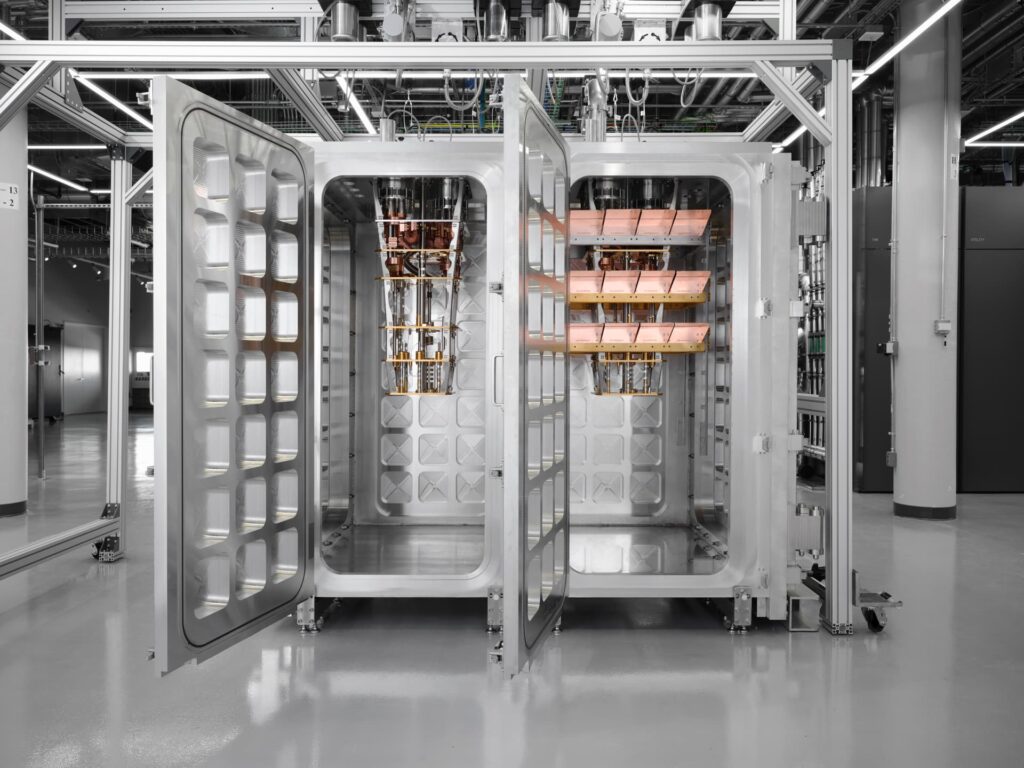
IBM has published a review of its progress towards Starling, the fault-tolerant quantum computer it promises for 2029. The company is sticking to the goal: running circuits of 100 million quantum operations on 200 qubits. And it says the core architecture has not changed, although it has redesigned the modular processors after this year’s results.
Starling is based on the ‘bivariate bicycle’ qLDPC error-correcting codes that IBM presented in 2024, built into modules that connect to each other. According to IBM, for the same logical error rate they need around ten times fewer physical qubits than earlier approaches. The post reviews six fronts that are moving forward at the same time.
What it says it has achieved
- On-chip couplers. On Loon, the test processor presented a year ago, it has measured relaxation times of around 200 microseconds and median gate errors of around 0.3%. Starling needs times in the milliseconds and errors of the order of 0.01%. The resonators in the ‘c-couplers’, which connect distant qubits on the chip, exceed a quality factor of 10 million, more than Starling requires, and it now uses three layers of them instead of two.
- Processors that are easier to make. An improvement to the code allows five connections per qubit instead of six, with logical errors between 20 and 100 times lower. With other changes to the couplers, the number of Josephson junctions per processor falls from around 5000 to 2000. With a yield of 99.95% per junction, IBM estimates that one processor in three would be fully working, compared with one in twelve.
- Decoder. Its Relay-BP decoder, the classical algorithm that locates the errors, already meets what Starling needs, according to IBM. It is preparing its own 2-nanometre chip to run it in real time.
- Links between modules. By joining two Nighthawk processors with four long-range couplers, the ‘l-couplers’, it obtained an average error of 1%, with a best result of 0.7%. Starling will need more than 100 per module with errors of 0.1%. Since November, two Nighthawk r2 processors joined in this way have been cooling down in its new modular cryostats; Starling will need up to twelve.
- Control inside the cryostat. Its new cryogenic control chips match or improve on, according to IBM, the gates obtained with room-temperature electronics.
Warning · what cannot be checked yet
This is a post on IBM’s blog about its own work. Apart from the link between two Nighthawk processors, which has a paper, most of the figures are not accompanied by a paper detailing how they were measured. The achievements are for separate components: there is not yet any Starling module working, nor fault-tolerant logical operations at that scale. And 2029 is the date IBM has set itself, not a result.
What changes for decision-makers
For anyone following the timeline of the quantum threat, the news is that the largest maker of superconducting processors still says it will be on time and gives interim milestones to measure it by: gate errors, reliability of the links, number of modules. Two hundred qubits and 100 million operations are a long way from what is needed to break RSA or elliptic curves, so it does not bring that date forward. But each component that is delivered reduces the uncertainty in the roadmaps, and post-quantum migration is planned around that uncertainty. We reported on the links between processors in October.